
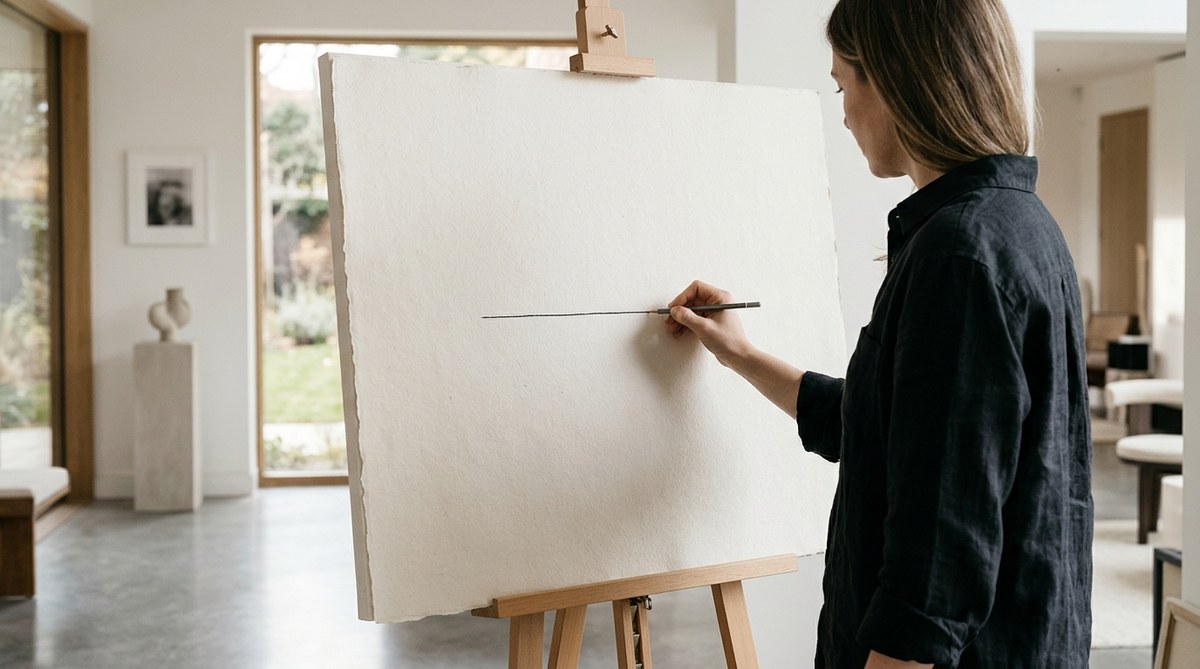
A single line drawn across a blank surface can stop you in your tracks. It sounds impossible. How could something so simple carry any weight at all? Yet that is exactly what the best minimalist art does. It strips away everything except the essential. And when you reduce an artwork to a single line, you are not left with nothing. You are left with everything that matters. The line becomes a boundary, a gesture, a breath held in space. It asks you to slow down and pay attention.
A single line in minimalist art is not a shortcut or a lack of effort. It is a deliberate act of removal. By eliminating color, texture, and complexity, the line becomes pure intention. It forces the viewer to engage with form, space, and meaning on a deeper level. Mastery comes from knowing exactly what to leave out.
Why a Single Line Carries So Much Weight
Think about the last time you saw a painting crammed with details. Your eye jumped around. You felt busy just looking at it. Now imagine a white canvas with one black line running from top to bottom. The difference is immediate. Your eye has nowhere to hide. You have to look at the line itself.
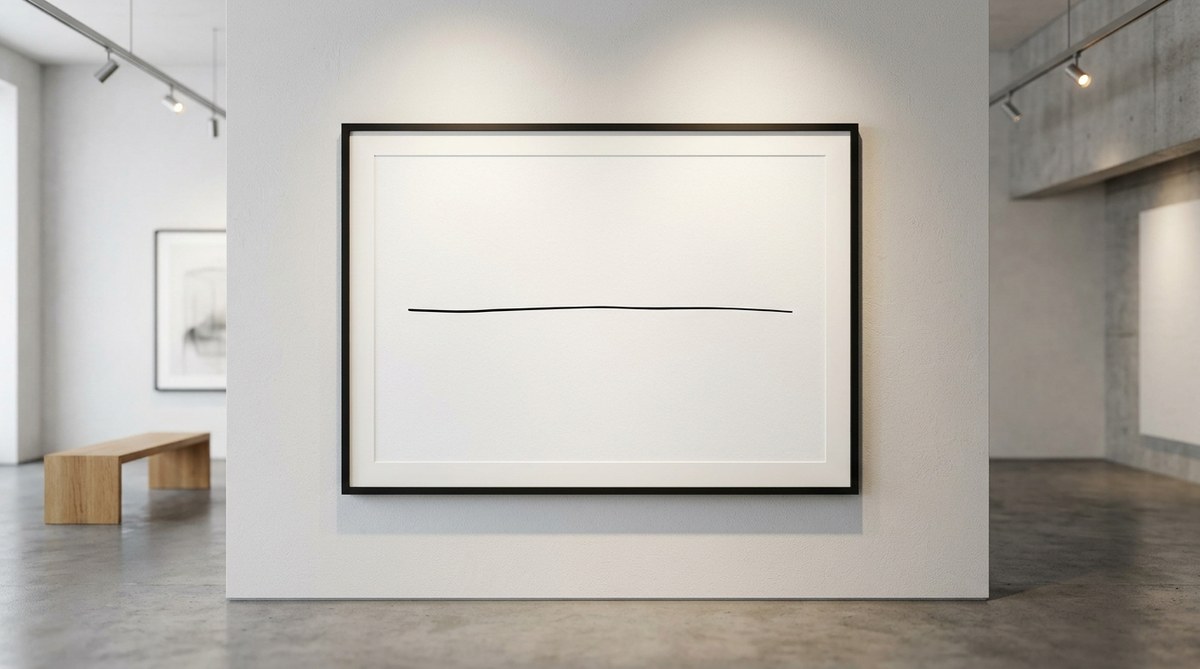
That is the secret. Minimalist art that uses a single line forces a conversation between the mark and the empty space around it. The line defines the void. The void gives the line its power. Without the silence of the blank canvas, the line would just be a mark on a page. Together, they become a complete statement.
Artists like Barnett Newman understood this. His “zip” paintings are famous for vertical lines that seem to split the canvas open. But the line is not just a divider. It is a seam, a connection, a source of light. Newman once said his work was about the sublime. He wanted the viewer to feel small and awestruck. And he did it with a single line.
The Philosophy Behind the Line
Minimalist art is not about making things easy. It is about making things true. When you remove everything that is not necessary, what remains is the truth of the form. A single line is honest. It does not pretend to be a tree or a person or a mountain. It is just a line. And in that honesty, it becomes universal.
Here is a breakdown of the core ideas that make a single line so powerful in minimalist art:
- Reduction as clarity: By removing everything else, the line becomes the only focus. There is no confusion about what to look at.
- Space as substance: The empty area around the line is not a mistake. It is an active part of the composition. It breathes.
- Gesture over detail: A single line can capture movement, tension, or calm better than a thousand brushstrokes. It is a record of a single action.
- Invitation to interpretation: Without a subject, the viewer must bring their own meaning. The line becomes a mirror for your own thoughts.
This is why a single line can feel profound. It is not telling you what to think. It is giving you room to think for yourself.
How to Approach Creating a Single Line Artwork
If you are an aspiring minimalist artist, you might wonder where to start. A single line sounds easy. It is not. The hardest part is deciding where to put it and how thick to make it. Every decision becomes magnified when there is nothing else to distract the eye.
Here is a practical process to help you begin:
- Start with intention. Ask yourself what feeling you want the line to carry. Is it calm? Is it urgent? Is it heavy or light? Your intention will guide the line’s shape and weight.
- Choose your surface. The size and color of your canvas matter. A white canvas feels open and infinite. A dark canvas feels heavy and enclosed. The surface sets the mood before you make a single mark.
- Select your tool. A thin pen creates a delicate, precise line. A wide brush creates a bold, physical mark. Charcoal gives you texture and softness. Ink gives you permanence and edge.
- Make one continuous gesture. Do not overthink it. Commit to the line in a single motion. You can practice on scrap paper first. But when you make the final mark, do not hesitate. The power of the line comes from its confidence.
- Step back and observe. Look at the line in relation to the empty space around it. Is it balanced? Does it feel too heavy on one side? Does the space around it feel alive? Adjust your next piece based on what you see.
This process is not about getting it right the first time. It is about learning to see the relationship between mark and void. That relationship is the heart of minimalist art.
Common Mistakes Beginners Make
When you first start working with a single line, it is easy to fall into traps. The table below outlines the most common mistakes and how to avoid them.
| Mistake | Why It Happens | How to Fix It |
|---|---|---|
| Making the line too thick | Trying to add drama through weight | Use a thinner tool and let the space create the drama |
| Placing the line in the center every time | Fear of imbalance | Practice placing lines off-center to create tension |
| Adding a second line for “balance” | Feeling like one line is not enough | Resist the urge. Trust that one line can hold the composition |
| Using too much pressure | Wanting to make a “strong” statement | Vary your pressure. A light line can be just as powerful |
| Overthinking the placement | Paralysis from too many choices | Set a timer. Make a decision in 30 seconds and commit |
The biggest mistake is thinking more lines will fix a weak one. They will not. If your single line does not work, adding more will only clutter the problem. Go back to intention. Make a new line with clearer purpose.
Learning from the Masters
You do not have to figure this out alone. Some of the most respected minimalist artists have spent their entire careers working with the single line. Their work is a masterclass in restraint.
- Barnett Newman used vertical lines, which he called “zips,” to create a sense of the sublime. His lines seem to vibrate against the color field around them. They feel alive.
- Agnes Martin drew faint, hand-drawn lines across her canvases. Her lines are soft, repetitive, and meditative. They feel like a quiet heartbeat.
- Richard Tuttle creates delicate, almost invisible line works that seem to float off the paper. His lines question the boundary between art and air.
Each of these artists uses the line differently. But they all share one thing: a deep respect for the space around the line. They understand that the line is only half of the artwork. The other half is the silence.
“The line is not alone. It exists because of the space that holds it. Remove the space, and the line becomes noise.” This is a useful mantra for any minimalist artist. The empty space is not empty. It is full of potential.
How to Read a Single Line Artwork
If you are an art enthusiast or design student, you might want to understand what makes a single line piece successful. Here is a simple framework for reading these works.
- Look at the line first. Notice its direction, thickness, and texture. Is it straight or curved? Does it start strong and fade away? The line itself tells a story.
- Look at the space around the line. Where does your eye go after you see the line? Does the space feel open or closed? Does it feel balanced or tilted?
- Look at the relationship between the two. Does the line feel like it belongs there? Does it feel like it is pushing against the edges of the canvas? Does it feel at rest or in motion?
A great single line artwork creates a feeling of rightness. It does not feel random. It feels inevitable. Like the line could not have been anywhere else.
Why This Matters for Your Own Practice
If you are a design student or an aspiring artist, working with a single line is one of the best exercises you can do. It teaches you discipline. It forces you to make decisions. It shows you that less really can be more.
Start a sketchbook dedicated to single lines. Fill one page a day. Do not judge the results. Just make the mark and observe. Over time, you will start to see patterns. You will learn what feels right and what feels off. You will develop an instinct for balance and tension.
This practice will change how you see all art. You will start noticing the empty spaces in paintings, photographs, and buildings. You will understand that what is left out is just as important as what is put in.
The Quiet Revolution of the Line
In 2026, we are surrounded by noise. Screens, notifications, advertisements, endless content. A single line of minimalist art is an antidote. It is a moment of quiet in a loud world. It asks you to stop scrolling and look at one thing. Just one.
That is why the most powerful minimalist art starts with a single line. It is not a limitation. It is a liberation. It frees the artist from the pressure to fill space. It frees the viewer from the clutter of information. It leaves room for something real to happen.
Start Your Own Single Line Practice Today
You do not need expensive materials. You do not need a studio. You just need paper, a pen, and a willingness to be honest. Draw one line. Look at it. Draw another. Compare them. Notice how your hand changes the line. Notice how your mood changes the line.
This is not about making gallery art on day one. It is about learning to see. It is about understanding that a single mark can hold the weight of a thousand words. And when you master that, you will never look at a blank page the same way again.
If you want to go deeper into this way of seeing, you might enjoy reading about how minimalist art transforms contemporary space through light and form. It builds on the same principles of reduction and intention.
The line is waiting. Pick up your tool. Make your mark. See what happens.

Leave a Reply