
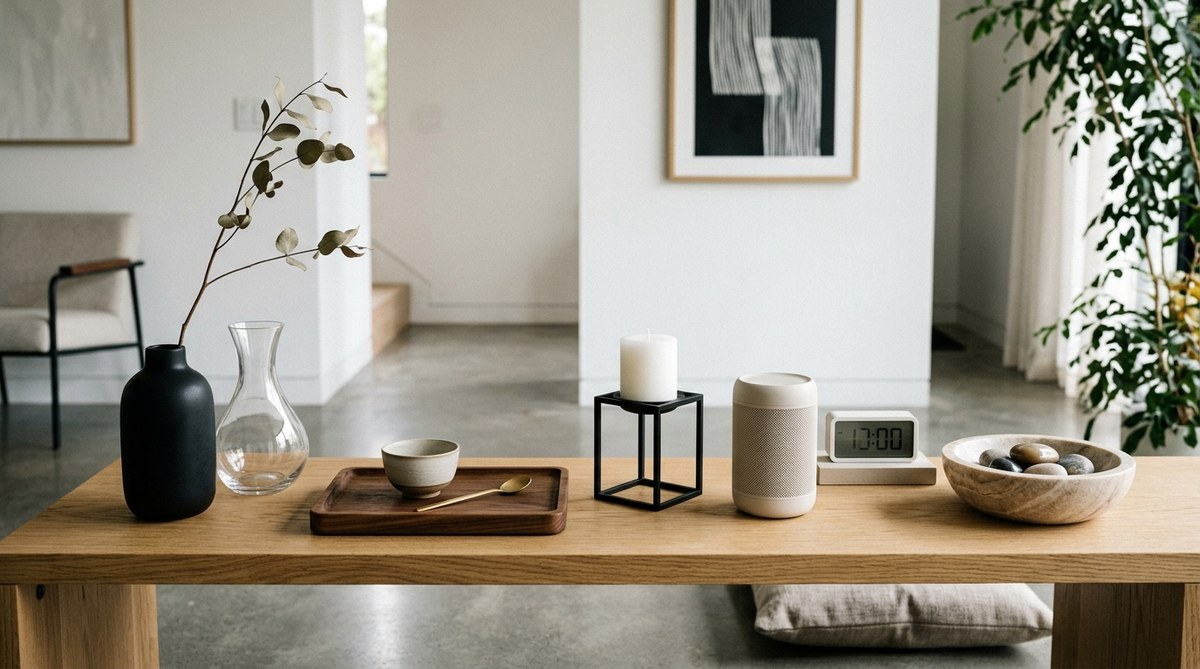
Most people think minimalist interior design means owning less stuff. That is only half the story. Real minimalism is about choosing better stuff and placing it with intention. It is about understanding how each object in your home affects how you feel, move, and rest. In 2026, as our homes juggle more roles than ever, the principles of minimalist object design offer a reliable way to create spaces that feel open, calm, and completely yours. No empty white rooms required. Just clarity, purpose, and a few thoughtful guidelines that anyone can follow.
Minimalist object design centers on five core principles that transform modern interiors into calm sanctuaries. Purpose drives every single piece you choose. Materials stay honest and true to their nature. Scale and proportion carefully respect the room around them. Color remains restrained and intentional. And negative space becomes an active design tool rather than empty area. These clear guidelines help homeowners and renters create spaces that feel open, intentional, and deeply personal without sacrificing function or a sense of warmth in the 2026 home.
Why Minimalist Object Design Matters in 2026
The way we use our homes has changed. Living rooms double as home offices. Dining tables become project stations. Bedrooms hold workout mats and meditation corners. When a space needs to do more, every object in it either helps or hurts.
Minimalist object design is not a style trend. It is a decision making framework. It helps you choose furniture, decor, and everyday items that support how you actually live. Instead of buying based on impulse or what looks good in a catalog, you learn to evaluate each piece for its role, its materials, its size, its color, and the space it leaves behind.
The result is a home that breathes. Surfaces stay clear. Your eye can rest. And the objects you do own carry more meaning because each one earned its place.
The Five Principles of Minimalist Object Design
These five principles work together. You do not need to follow them perfectly from day one. But the more you apply them, the more natural they become.
Principle 1: Purpose Before Decoration
Every object in your home should serve a clear function. That function can be practical (a chair for sitting) or emotional (a vase that brings you joy). But it must exist. Decoration for its own sake is where clutter begins.
Ask yourself: What does this object do for me? If the answer is vague or relies on the idea that you might use it someday, it probably does not belong in your space.
This principle applies to big purchases like sofas and to small ones like candle holders. A minimalist home is not against decoration. It just insists that decoration have a reason to be there.
For a deeper look at how simplicity shapes modern spaces, read about the art of simplicity in object design for modern spaces.
Principle 2: Material Honesty
Minimalist design values materials for what they are. Wood is wood. Stone is stone. Linen is linen. There is no need to pretend that particle board is oak or that polyester is silk.
When you choose honest materials, two things happen. First, the objects age gracefully. Wood develops a patina. Leather softens over time. Stone gains character. Second, your space feels more grounded. There is a tactile honesty that your body recognizes even if your mind does not.
Focus on natural or quality materials that improve with use. Avoid anything that tries to mimic something it is not. That includes cheap laminates, plastic wood grain, and synthetic fabrics that do not breathe.
Principle 3: Proportion and Scale
An object that looks perfect in a showroom can look wrong in your living room. That is not the object’s fault. It is a mismatch of scale.
Proportion is about how the parts of an object relate to each other. Scale is about how an object relates to the room and the other objects around it. A massive sectional sofa can overwhelm a small apartment. A tiny side table can look lost next to a deep armchair.
Before buying any piece, measure your space. Use painter’s tape on the floor to map out furniture dimensions. Leave room to walk. Leave room to breathe. A well scaled room feels comfortable even when it contains very few objects.
Principle 4: Restrained Color Palette
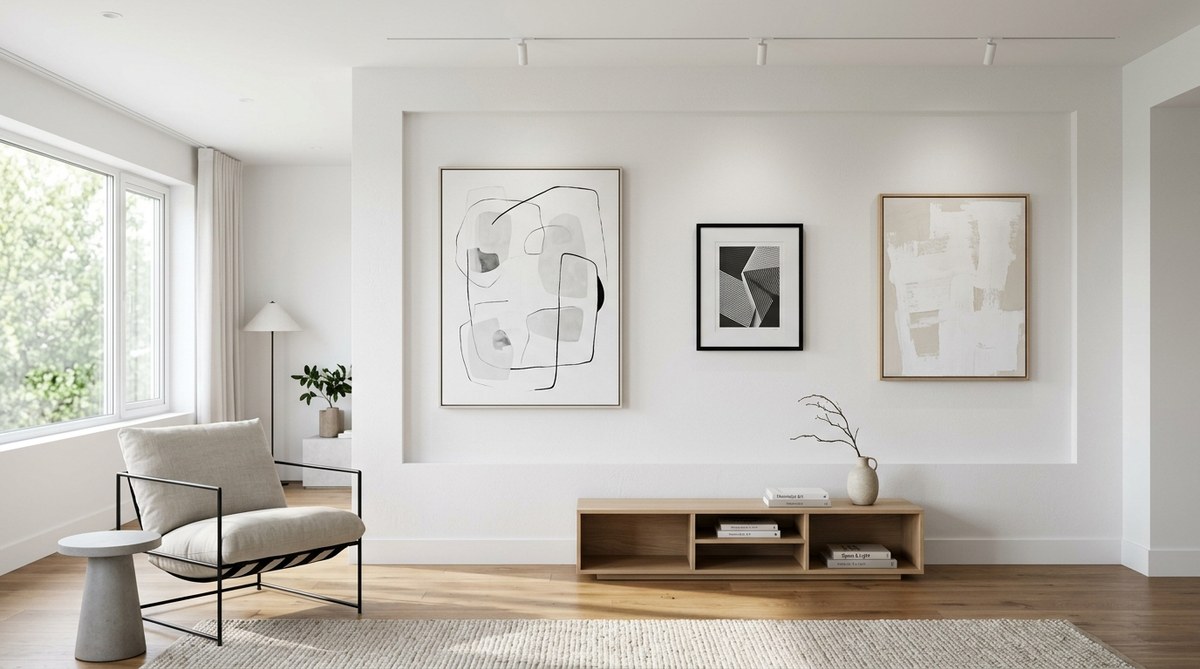
Minimalist interiors rely on a limited set of colors. That does not mean everything must be white. Warm beiges, soft grays, muted greens, and earthy browns all work beautifully. The key is restraint.
Stick to two or three main tones across your larger pieces. Use one accent color sparingly. A single rust colored throw pillow or one deep blue ceramic vase can provide visual interest without breaking the calm.
The goal is visual quiet. When every surface shouts for attention, your brain never stops processing. A restrained palette lets your eyes rest and your mind settle.
Principle 5: Negative Space as a Design Tool
Negative space is the empty area around and between objects. In minimalist design, it is not wasted space. It is active. It gives each object room to be seen and appreciated.
Think of negative space as the silence between notes in music. Without it, the notes would blur together. The same is true for your home. A bookshelf that is completely full feels chaotic. A shelf with books, a small plant, and breathing room feels curated.
Aim to leave roughly thirty to forty percent of horizontal surfaces empty. That includes countertops, shelves, and tabletops. The empty areas are not gaps. They are design choices.
Learn more about how emptiness shapes a room by reading about mastering spatial harmony through minimalist art and design.
Common Techniques versus Common Mistakes
Here is a table that summarizes the right way to apply each principle and the pitfalls to avoid.
| Principle | Correct Technique | Common Mistake |
|---|---|---|
| Purpose Before Decoration | Ask what function an object serves before buying it | Keeping items purely out of guilt or obligation |
| Material Honesty | Choose natural materials that age well | Using synthetic veneers to mimic expensive finishes |
| Proportion and Scale | Map furniture dimensions on the floor with tape before purchasing | Buying oversized pieces that crowd the room |
| Restrained Color Palette | Limit your palette to two or three neutral tones | Adding too many accent colors that compete for attention |
| Negative Space as a Tool | Leave surfaces partially empty for visual breathing room | Filling every shelf and countertop with decor |
How to Audit Your Own Space Using These Principles
You do not need to start from scratch. You can apply these principles to your existing home one step at a time. Here is a simple process to follow.
- Walk through each room with a notepad. List every object that is visible. Do not judge. Just write it down.
- Mark each object with a purpose. Next to each item, write one sentence about what it does for you. If you cannot think of a real purpose, put a star next to it.
- Check the stars. These are the objects most likely to become clutter. Decide if you can relocate them, donate them, or let them go.
- Look at the remaining objects. Do they respect the five principles? Do they use honest materials? Do they fit the scale of the room? Are the colors within your palette? Is there enough negative space around them?
- Make one change at a time. Move one piece. Remove one item. Swap one accent. Live with the change for a few days before making another.
This process works for any room. It works for renters who cannot paint walls. It works for homeowners planning a full redesign. The principles are flexible. The goal is always the same: a home that supports your life without adding visual noise.
The Benefits of Applying These Principles
When you consistently apply minimalist object design principles, your home starts to feel different. Here is what changes.
- Your morning routine gets smoother because surfaces are clear and items are easy to find.
- Your stress levels drop because your eyes are not constantly processing clutter.
- Your spending becomes more intentional because you evaluate each purchase against clear criteria.
- Your space feels larger without renovation because negative space creates visual openness.
- Your belongings carry more meaning because each piece has earned its place.
“Minimalism is not about having less. It is about making room for more of what matters. When you apply clear principles to the objects you own, your home stops competing for your attention and starts supporting your life.”
Interior designer and minimalism advocate, featured in multiple design publications in 2026
Making These Principles Work in Your Home
The five principles of minimalist object design are not rules written in stone. They are tools you can adapt to your own space, your own style, and your own life. You might find that purpose matters most in your kitchen while negative space matters most in your living room. That is fine. The principles are meant to guide you, not restrict you.
Start with one room. Pick the principle that feels most natural and apply it there. See how it changes the way the room feels. Notice how it changes the way you feel in the room. Then try another principle in another room. Over time, these guidelines become second nature.
Your home should be a place where you can relax, focus, and connect with the people around you. By choosing objects with purpose, honest materials, proper scale, restrained color, and room to breathe, you create a space that does exactly that. No trends needed. No expensive makeover required. Just thoughtful choices, one object at a time.

Leave a Reply