
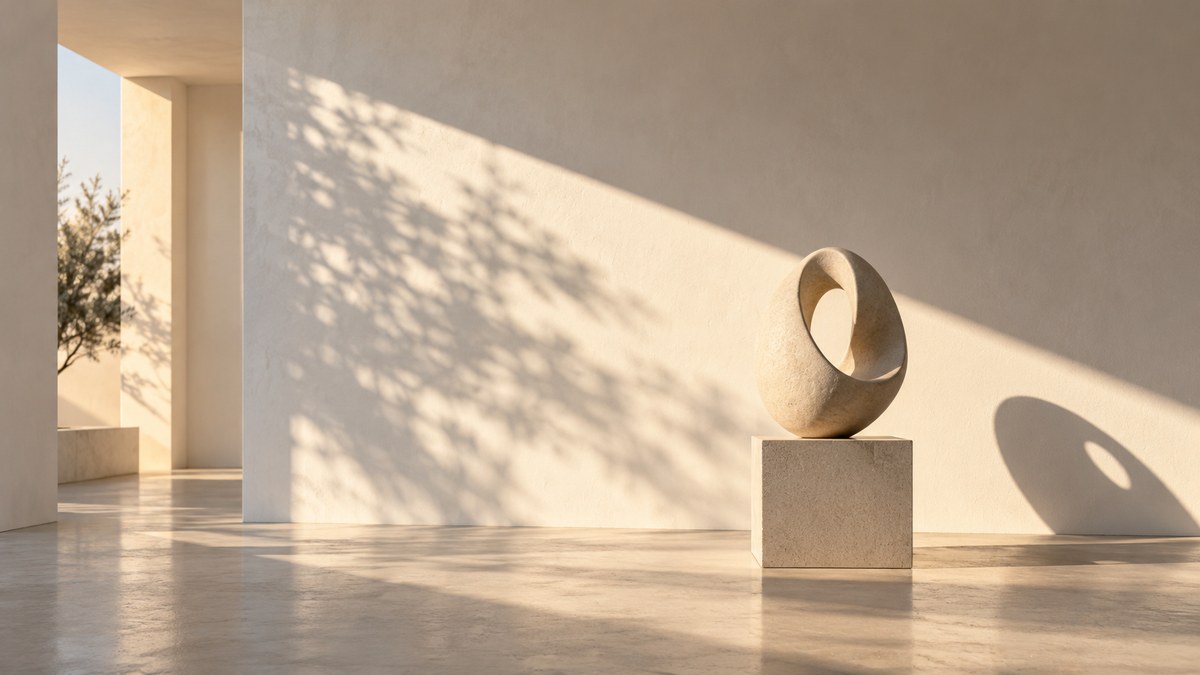
Light is the obvious star in any gallery. But the real magic happens when you start thinking about what light leaves behind. Shadow as a design tool minimalist art spaces is a concept that separates good installations from unforgettable ones. When you strip a room down to its essentials, every shape and every void starts to carry weight. Shadows are not accidents. They are intentional marks that define volume, create rhythm, and guide the eye.
Shadow is not the absence of design. It is a deliberate tool that adds depth, texture, and movement to minimalist art spaces. By controlling light sources, angles, and object placement, you can turn empty walls and simple forms into dynamic compositions that change throughout the day.
Why Shadow Belongs in Your Minimalist Tool Kit
Minimalism is about subtraction. You remove clutter, noise, and distraction. But a room without shadow can feel flat and lifeless. Think of a white gallery with even lighting. It feels sterile. Now imagine the same room with a single beam of light hitting a concrete column at a low angle. The shadow stretches across the floor. The space suddenly has a second dimension. It breathes.
Shadows create contrast. They define the edges of an object without adding more objects. In a minimalist space, you do not need more furniture or art. You need more tension between what is lit and what is not. That tension is what makes a viewer stop and look.
Shadows also change over time. A morning shadow is long and soft. An afternoon shadow is sharp and short. This gives your space a living quality. It becomes a collaboration between the sun and your design choices.
The Technical Side of Casting Intentional Shadows
To use shadow as a design tool minimalist art, you need to understand three variables: the light source, the object, and the surface. Change any one of them and the shadow changes completely.
-
Choose your light source carefully. A single point light, like a spotlight or the sun through a small window, creates hard, defined edges. A diffused light, like an overcast sky or a softbox, creates soft, blurry shadows. For minimalist spaces, hard shadows usually work better because they create clear geometry.
-
Control the angle of incidence. A light placed directly above an object pushes the shadow straight down. That hides the shape. A light at a 45 degree angle stretches the shadow and reveals texture. A light at a very low angle, almost parallel to the floor, makes the shadow long and dramatic.
-
Consider the object’s silhouette. The shadow is a projection of the object’s outline. If you want a clean shadow, use a clean object. A simple cube, a sphere, or a flat plane will cast a predictable shape. Complex objects create chaotic shadows that can feel busy in a minimalist room.
-
Use the surface as a canvas. The floor, wall, or ceiling where the shadow lands is just as important as the object. A rough concrete floor will soften the shadow’s edge. A polished white wall will make it razor sharp.
-
Test at different times of day. If you are using natural light, map out where the shadow falls at 9 AM, noon, and 4 PM. Design the layout around the best moment. If you are using artificial light, you can lock in the look and keep it consistent.
Common Mistakes and How to Fix Them
Even experienced designers can make errors when working with shadow. Here is a table that shows the most frequent problems and the simple adjustments that solve them.
| Mistake | Why It Happens | The Fix |
|---|---|---|
| Shadow is too faint | Light source is too diffused or too far away | Switch to a point light or move the source closer |
| Shadow is distracting | The object’s shape is too complex | Use a simpler form, like a cylinder or flat slab |
| Shadow falls on a busy area | The surface has patterns, seams, or textures | Reposition the object or light to hit a blank wall |
| Shadow changes too much during the day | Natural light moves across the room | Install a fixed artificial light to control the angle |
| Shadow makes the room feel smaller | The shadow is cast toward the viewer | Angle the light so the shadow falls away from the main path |
A Practical Process for Designing with Shadow
If you are setting up a new space or rethinking an existing one, follow these steps to make shadow an active part of your design.
-
Start with an empty room. Place one object in the center. A simple stool, a sculpture, or even a single plant. Turn on one light source. Watch the shadow. Move the light in small increments. Notice how the shadow changes length and direction.
-
Mark the shadow shape on the floor with tape. This helps you see the negative space it creates. Ask yourself: does this shadow add to the composition? If the answer is no, move the object or change the light angle.
-
Add a second light source only if the first one is not enough. In minimalist design, one light is often better than two. Two lights can create conflicting shadows that confuse the eye.
-
Photograph the setup. A camera lens can reveal things your eyes miss. Look at the photos in black and white. This removes color distraction and lets you see the shadow structure clearly.
-
Live with the setup for a day. Shadows shift with time. What looks good at 2 PM might disappear at 5 PM. Adjust until the shadow works during the hours the space is used most.
“The shadow is not a mistake. It is the proof that the object is real. In minimalism, the shadow is the only ornament you need.” – Tadao Ando, architect
Objects That Work Best for Casting Shadows
Not every object is a good shadow maker. Here are the types of forms that produce the most interesting results in a minimalist context.
- Flat planes. A thin sheet of metal or wood can cast a clean line shadow that acts like a drawn line on the wall.
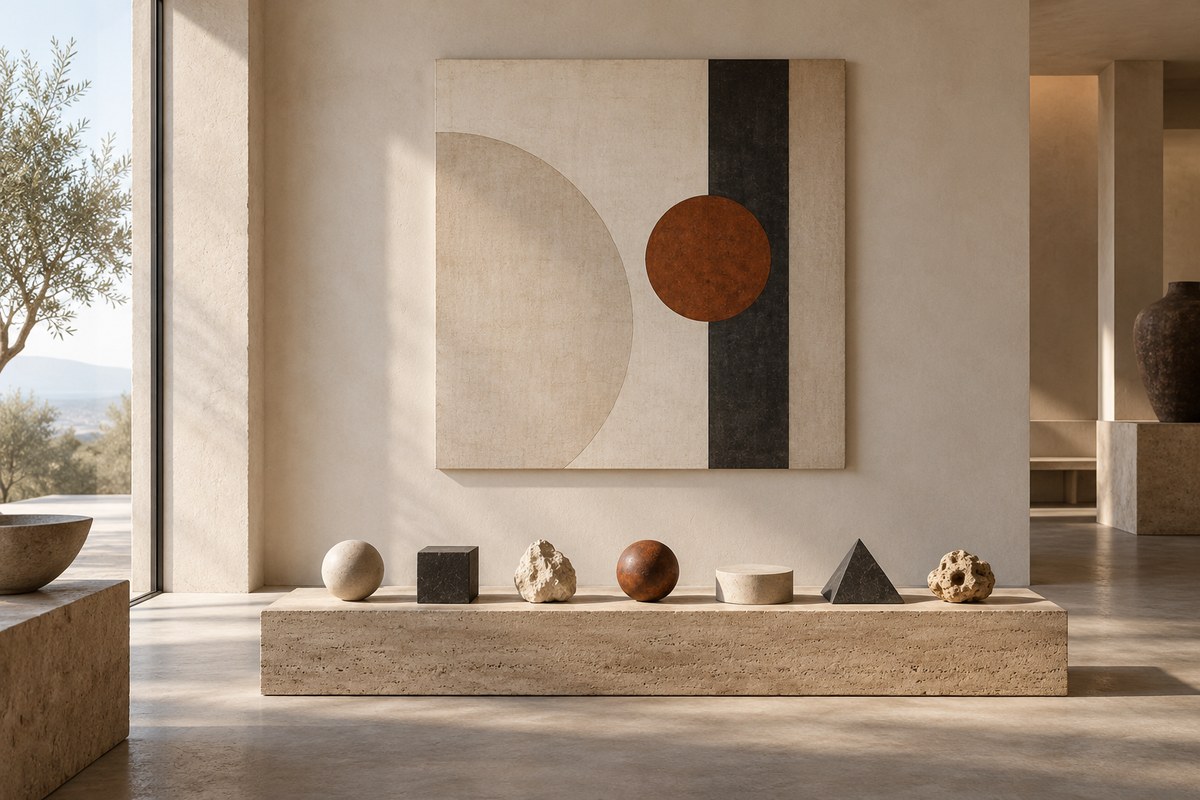
- Geometric solids. Cubes, spheres, and pyramids create predictable, readable shadows that echo the object’s form.
- Linear elements. A single rod or wire can cast a shadow that reads as a drawing in space.
- Perforated surfaces. A screen with holes or a mesh can cast a pattern of light and dark dots that adds texture without clutter.
If you are looking for more ideas on what to place in your space, check out our guide on the impact of object simplicity on modern art installations. It covers how even the most basic forms can become powerful tools.
Using Shadow to Define Zones in Open Spaces
Open floor plans are common in modern galleries and lofts. But without walls, it can be hard to define where one zone ends and another begins. Shadow can solve that problem.
Cast a shadow across the floor to create a visual boundary. For example, a light fixture hung low over a seating area will cast a soft shadow ring around the furniture. That ring tells the viewer “this is a place to stop.” It works like an invisible wall.
You can also use shadow to lead the eye. A long shadow that stretches from the entrance toward the back wall acts like a directional arrow. It pulls visitors deeper into the space without a single sign or line on the floor.
For more on how light and form work together, read the art of light and space in minimalist interior design. It goes deeper into the relationship between illumination and spatial perception.
When to Break the Rules
Every design principle has exceptions. Sometimes a soft, diffused shadow is exactly what a room needs. If your space already has strong architectural lines, a hard shadow might compete with them. In that case, a gentle shadow that barely registers can add a layer of subtlety.
Another exception is when the shadow is the art itself. Some artists create installations where the shadow is the main event and the object is just a prop. In those cases, the rules about simplicity and clarity still apply, but the goal is different. You want the shadow to be complex and surprising.
If you are working on a project where the shadow takes center stage, consider reading about 8 minimalist art installations redefining spatial design in 2026. It shows how contemporary artists are pushing the boundaries of light and darkness.
The Emotional Effect of Dark and Light
Shadows are not just visual. They affect how people feel. A room with deep shadows feels intimate and quiet. A room with no shadows feels exposed and cold. In a minimalist art space, you want a balance.
A good rule of thumb is to keep about 60 percent of the room in light and 40 percent in shadow. That ratio feels calm but not sterile. Adjust it based on the mood you want. More shadow for a meditative space. More light for a social one.
The color of the shadow also matters. A shadow on a white wall is gray. A shadow on a warm beige wall is a deeper brown. A shadow on a blue wall is a darker blue. The shadow takes on the color of the surface it lands on. Use that to your advantage when choosing wall colors.
For more on the psychology of empty space, see why minimalist art spaces inspire a sense of calm and clarity. It explains how subtraction creates emotional safety.
Putting Shadow to Work in Your Next Project
Shadow as a design tool minimalist art is not a trend. It is a fundamental technique that has been used by architects and sculptors for centuries. The difference today is that we have better control over light sources and a deeper understanding of how people experience space.
Start small. Pick one corner of your studio or gallery. Place one object. Play with one light. Watch what happens. Take notes. Take photos. Let the shadow teach you what the object is really about. Once you see the potential, you will start noticing shadows everywhere. In the way a tree branch hits the sidewalk. In the way a window frame projects onto a rug. All of that is material you can use.
If you want to go further, our article on how to use minimalist light design to enhance your gallery experience offers specific product recommendations and setup diagrams. It is a natural next step after mastering the basics of shadow.
Designing with the Absence of Light
The best minimalist spaces do not shout. They whisper. And the quietest voice of all is the shadow. It does not ask for attention. It simply exists. When you design with shadow, you are designing with the space between things. That is where minimalism lives.
Next time you walk into a room, look at the floor. Look at the wall behind the furniture. Ask yourself: where is the shadow? Is it intentional? Could it be better? Those small questions will change the way you build your spaces.
Start today. Turn off the overhead lights. Find a single lamp. Point it at something simple. Watch the shadow appear. That is your first step toward using shadow as a design tool minimalist art spaces. And it costs nothing but a few minutes of your time.

Leave a Reply